
Serving the U.S. and clients worldwide since 2004
Study in Spain

Spain student visa: FBI check, apostille and translation
Practical guide · Published July 30, 2026

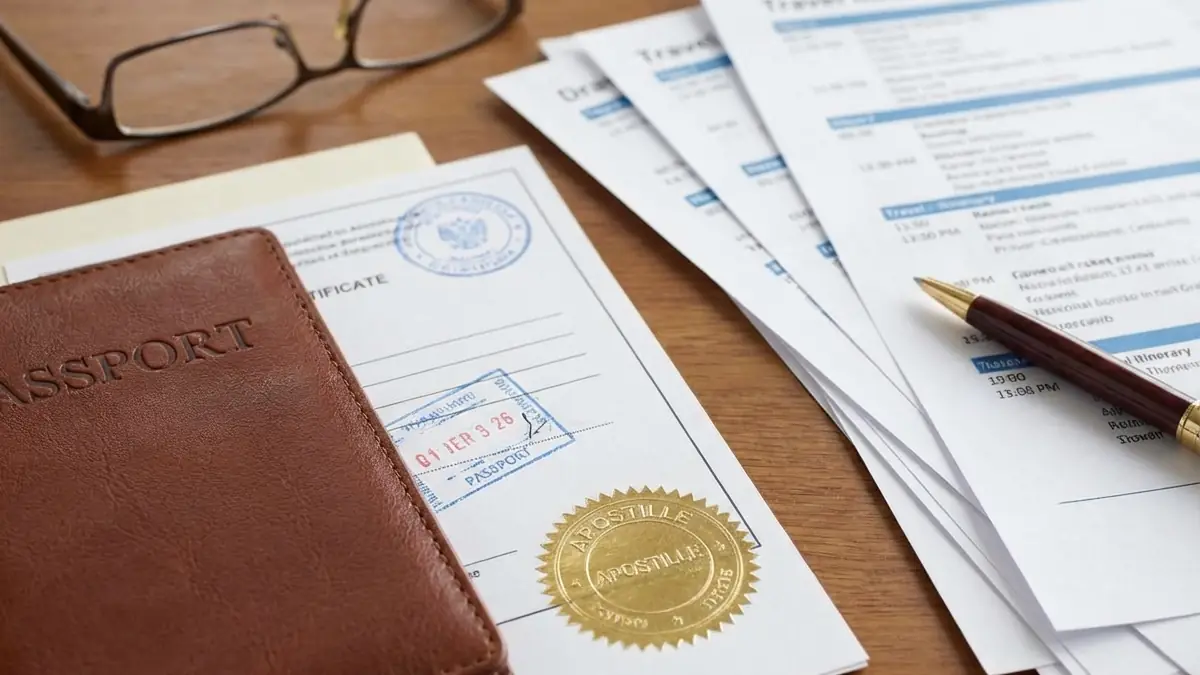
Passport, apostilled document and travel itinerary on a desk
Illustrative image; it does not represent an official document.

A Spanish study plan is really three separate files: academic admission, the visa itself and, if it comes up later, credential recognition. The FBI check belongs only to the immigration file, and it follows a specific federal route that should not be confused with the path other documents in the same application take.

Quick summary

For a study visa of more than 180 days in the Washington consular district: FBI Identity History Summary, then a federal apostille from the U.S. Department of State, then an official/certified Spanish translation. A state apostille will not work for the FBI report.

When the criminal-record requirement applies

The Embassy of Spain in Washington states that applicants age 18 or older must submit a criminal record whenever the total length of intended stay in Spain exceeds 180 days. That can happen even when the academic program itself runs 180 days or less, if the extra days authorized before or after the program push the total stay past that limit. For U.S. residents, the required record is the FBI report; a local police certificate, a county sheriff's letter or a state repository check does not replace it, even if it covers the same period of residence. Minors and shorter stays can follow different rules, so it is worth confirming the exact visa category and the current instructions of the consulate handling the application before starting the process.

Applicants who spent more than 180 days in another country during the last five years also need a criminal record from that country, per the Washington consulate's requirements. Records issued by an EU member state do not need an apostille for this purpose; other foreign documents must go through whatever authentication applies for the issuing country.

Why the FBI report, not a state or local check

The FBI report, known as the Identity History Summary, is the federal record the Spanish consulate in Washington requires for this purpose; state or local records do not substitute for it. That is why it is the document eligible for a U.S. Department of State apostille: the apostille authenticates the signature and official capacity of whoever issues the document, and that signature is only valid at the federal level when the underlying document is itself a federal one. A state or municipal police certificate, by contrast, is apostilled, when it needs to be, by the secretary of state of the state that issued it, not by the federal government. Submitting the wrong document, or apostilling it at the wrong level of government, usually means starting the process over. Validity also matters: for the Washington consular district, the report must have been issued within the six months before the visa application is submitted. Other consulates may publish their own instructions, so always check the current checklist for your district.

The right order: apostille first, then translation

The usual sequence is to request the FBI report, either by mail directly from the agency or through an FBI-approved channeler that speeds up electronic delivery, then obtain the U.S. Department of State apostille on that report, and only at the end arrange the official Spanish translation the consulate asks for. If you use a channeler, confirm it appears on the FBI's official list of approved channelers before requesting the report that way. For the Washington consular district, the criminal record must be accompanied by an official translation from a sworn or certified translator; the apostille itself does not currently need to be translated. Always confirm the translation requirement in effect with the consulate handling your application, since instructions can vary by district and change over time. Do not have the FBI report apostilled by any state's secretary of state, and do not notarize the original before mailing it: both steps add certifications that the Department of State does not recognize as part of the correct chain and can slow the process down.

Keep academic and immigration documents separate

It is easy to lump together papers that actually follow different routes. The Spanish university's acceptance letter, for instance, typically does not need an apostille because it is issued by a foreign institution for its own use; a U.S. transcript or diploma that the receiving university asks to have legalized, on the other hand, may need a state apostille and translation, following a route separate from the criminal-record one.

  • Academic admission: acceptance letter, transcripts, diplomas and any other document the Spanish institution requires, generally evaluated on its own terms.
  • Student visa: valid passport, application forms, proof of funds, medical insurance, medical certificate and a criminal record when the length of stay calls for one.
  • Credential recognition: a separate, usually later procedure that can require academic documents legalized and translated through a different route than the visa.

A common scenario: a student who already has an acceptance letter and only needs to resolve the criminal-record piece for the visa should not also start a diploma legalization that the program does not yet require; it is better to first ask what the consulate actually needs for the visa, and leave recognition for when it genuinely becomes necessary.

Planning the timeline backward

Current Washington guidance recommends filing between six and two months before the program begins and, absent a justified exception, at least two months beforehand. To avoid a last-minute scramble, it helps to plan backward from the program start date or the consular appointment, rather than starting with whichever document happens to be easiest to obtain first:

  1. Confirm the program start date and, once you have it, the consular appointment date.
  2. Count back the minimum filing window the consulate requires.
  3. Within that window, set aside time for the FBI report, which can take longer by mail than through an electronic channeler.
  4. Add the time needed for the Department of State apostille, which varies with volume and season.
  5. Leave the official translation for last, once the document is already apostilled and will not be modified further.
  6. Build in an extra cushion before the appointment, without ordering so far ahead that other documents, such as recent bank statements, expire.

FBI processing times, apostille turnaround and the consulate's own timelines all vary by season and demand; always confirm the current estimate when you apply rather than relying on how long it took someone else.

Protect the physical integrity of the apostilled document

The apostilled FBI report is usually delivered as a set of pages stapled or otherwise bound together, linking the original document to the apostille certificate. Removing the staple, separating the pages to scan them, or reordering them can lead the consulate to treat the document as altered and reject it, even if the content itself has not changed. If you need a digital copy, scan the whole set without taking it apart, and check with whoever is handling the translation on the correct way to work with the original without compromising it.

Accompanying family members

When a spouse, partner or children travel with the student, the family's file usually adds documents of its own. Records that prove the relationship, such as marriage or birth certificates issued in the United States, generally follow the state apostille route, meaning the route of the state that issued them, not the FBI's federal route. It is therefore common for one family's application to combine a federal apostille for the student's criminal record with one or more state apostilles for the accompanying family members' civil records, each with its own official translation.

What the apostille does not guarantee

The apostille authenticates the origin of a public signature and seal; it does not certify that the content of the FBI report is favorable, and it does not guarantee that the consulate will approve the visa. The final decision on the application belongs solely to the consular authority, which evaluates the complete file. Having the FBI report, apostille and translation in order is a necessary condition for a complete application, not, by itself, a guarantee of the outcome.

FAQ

Frequently asked questions

Have more questions? Send us your specific case and we'll walk through it with you.

Do I need the FBI report if my program is under 180 days?+
The requirement is based on the total length of intended stay in Spain, not just the length of the academic program. Even if the program itself runs 180 days or less, if the extra days authorized before or after it push the total stay past 180 days, a criminal record is required. For stays that stay under that total, confirm with the consulate handling your case whether a criminal record is still required.
Will a state apostille work for the FBI report?+
No. The FBI report is a federal document, and only the U.S. Department of State can apostille it; an apostille issued by a state is not valid for this document.
Can I separate the apostilled pages to scan them?+
It is not advisable. The Spanish consulate in Washington states that the criminal record will not be accepted if it has been altered or damaged, including damage caused by removing staples. Altering the original set, the staple, page order or binding, can lead the consulate to reject the document as altered or damaged.
What order should the apostille and translation go in?+
The apostille is obtained on the FBI report first, once it has been issued, and the official Spanish translation the consulate requires comes afterward. For the Washington consular district, the apostille itself does not currently need to be translated, but it is worth confirming the current requirement with the consulate before sending the translation out.
Does the apostille guarantee my visa will be approved?+
No. The apostille only authenticates the origin of a public signature or seal; the visa decision rests with the consulate, which weighs the entire file.
Does my academic acceptance letter also need an apostille?+
Not necessarily. The acceptance letter is typically issued by a foreign institution for its own use; the apostille requirement mainly applies to U.S. documents, such as the FBI report or, in some cases, diplomas and civil records.
Can I reuse an apostilled FBI report I already obtained for another country?+
Only if it is still considered current by the consulate's standard. For the Washington consular district, the report must have been issued within the six months before the application is submitted, so a report apostilled further back than that will likely not be accepted even though its content has not changed. Other consulates may set their own timeframe, so always confirm the current standard with the consulate handling your case.

Informational content only. Integramerica is not a law firm and does not provide legal advice. Requirements and final acceptance depend on the receiving authority. Integramerica provides document preparation, apostille, legalization, translation, and attorney referrals when appropriate; it does not determine visa eligibility. Official requirements last reviewed: August 2026.

Contact

Want to confirm the route for your documents?

Send us the document type, issuing state or agency and destination country. We review the document route before you incur unnecessary expense.

Request your document review

Examples: Florida, New York, FBI, U.S. Department of State.
Call us

Please do not include Social Security numbers, financial account information or other highly sensitive personal data.

WhatsAppCallEmail