
Serving the U.S. and clients worldwide since 2004
Study in Spain

Diplomas and transcripts for studying in Spain: when they need an apostille
Practical guide · 8 min read · Published July 30, 2026

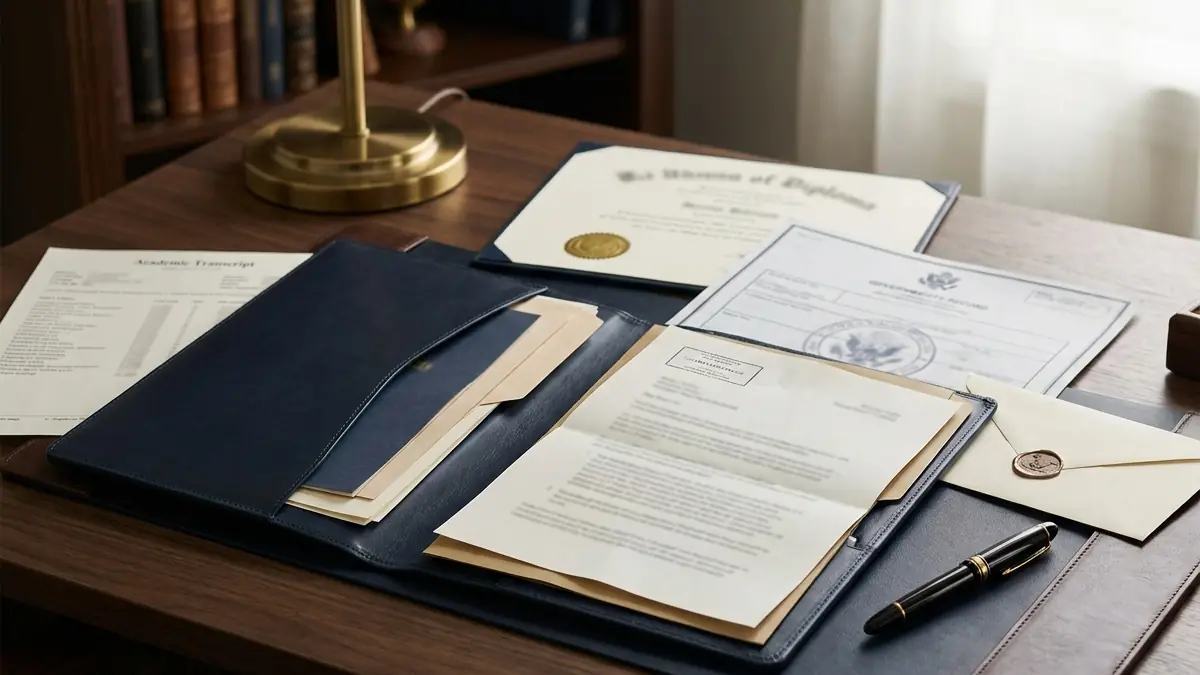
Diploma and academic transcript on a desk, ready to be apostilled
Illustrative image; it does not represent an official document.

“Studying in Spain” usually involves three separate procedures that move forward almost in parallel: university admission, official recognition of the degree (homologación, equivalency or validation, depending on the case) and a student visa. Each one is decided by a different authority, with its own document list and its own timeline. Preparing a single package of diploma, transcript and certifications on the assumption that it will serve all three at once is the most common reason for extra apostilles, repeated translations and copies that none of the three offices end up accepting.

Quick summary

Not every university document follows the same route toward Spain: the university decides which diploma, transcript or copy it accepts for admission; academic recognition (homologación, equivalency or validation) may require an apostille and translation depending on the procedure; and the visa follows a separate immigration file. Do not apostille everything in advance: confirm first exactly which document each authority is asking for.

Three separate processes

Before requesting a single certification, it helps to understand what each authority decides and what it needs to see in order to decide it. Not every student goes through all three: a one-semester exchange may not require credential recognition at all, and some graduate programs ask for recognition before formal admission is even complete. Confirm which of the three apply to your situation before you start gathering documents.

  • Admission: the university decides which degrees, grades and copy formats it will accept to evaluate a candidate; the rules are set by each institution, not by a single national standard.
  • Recognition: homologación, equivalency or validation of a foreign degree follows procedures set by the Spanish education authority and is generally independent of whether the university has already admitted the student.
  • Visa: the consulate reviews the length of stay, enrollment, funds, health insurance, criminal background and other immigration requirements that have nothing to do with the academic content of the degree.

Common academic records: diploma, transcript and certifications

An academic file can include pieces with similar names but different functions. The diploma or degree certifies that the degree was conferred; it is usually a short document bearing the signature of an institutional official (president, dean, registrar) with little additional detail. The transcript is more extensive: it lists courses, credits, grades and dates, and it is precisely what a recognition authority or a foreign university uses to compare the course of study and course hours against the Spanish system. In recognition procedures, the transcript often carries as much weight as the diploma itself, sometimes more.

Some procedures also ask for course syllabi (to compare content, not just course titles) or a registrar's letter certifying the institution's accreditation. Always ask for the exact name and format the receiving authority expects; a “grade report” printed from the student portal does not always match the official sealed document a university or recognition office is asking for.

Original diploma or a certified copy from the registrar

One point that is frequently overlooked: the physical diploma you received on graduation day cannot always be apostilled directly. Many state apostille offices only authenticate the signatures of public officials or notaries, not a document by itself. When the diploma does not carry a signature that office can directly authenticate, the usual path is to ask the registrar for a certified true copy of the original, have a notary certify that copy, and then apostille the notary's or the registrar official's signature, depending on the state's procedure.

A transcript, by contrast, is usually issued directly by the registrar in a sealed envelope bearing an institutional signature. The exact way to prepare it for an apostille depends on the state and on how the institution issues or certifies the document: some states may require a notarized statement or certification from the registrar, while others follow a different authentication chain. Before requesting copies, confirm with the registrar and with the state's apostille authority which format they accept.

Every state has its own procedure for diplomas and transcripts, and every institution has its own policy for issuing certified copies. Do not assume that the process that worked for a civil record applies the same way to an academic document: confirm with your institution's registrar and with the apostille office of the issuing state before requesting copies or scheduling appointments.

Why apostilles are usually issued at the state level

Diplomas and transcripts issued by U.S. state or private universities normally follow a state-level authentication route, because the signature being authenticated (that of an institutional official or a notary) acts under state authority, not federal authority. Most U.S. universities, community colleges and institutes are not federal entities; they are state or private institutions authorized to operate within a given state, and that is why the signature is apostilled by the Secretary of State of the state where the document was issued or notarized. Documents issued by a federal agency follow a different, federal route: the U.S. Department of State apostilles, for example, FBI background checks or special cases such as diplomas from federal service academies.

This has a practical consequence: if you graduated in one state and now live in another, it is the state where the document was issued or notarized, not your current place of residence, that determines which apostille office needs to be involved.

Apostille for homologación, validation or equivalency

When a Spanish authority requires legalization of a U.S. academic document, and that document falls within the scope of the Hague Apostille Convention, the usual route is an apostille issued by the competent authority in the United States; the exact requirement should be confirmed within the specific homologación, equivalency or validation procedure that applies. The terms “homologación,” “convalidación” and “equivalencia” are not interchangeable; each refers to a distinct procedure, and requirements can vary by degree level (bachelor's, master's, doctorate) and, in some cases, by whether the profession is regulated in Spain. Confirm with the receiving authority exactly which procedure applies to your degree before gathering documents, since each one can call for a different combination of apostilles, translations and additional certifications.

Official translation: complete and true to the original's structure

When a document is not in Spanish, the procedure typically requires an official translation. Two points cause the most costly mistakes. First, the translation must be complete: not a summary or an abridged version, but a faithful rendering of every element of the original, including seals, marginal notes, text on the back of the page and any attached certification. Second, do not assume the apostille itself also needs to be translated; that depends on the receiving authority. Some consulates and offices require the apostille, seals and any attached certifications to be translated along with the underlying document; others do not. Confirm the exact scope of the translation before requesting the service, because if the apostille does need to be translated it is best to apostille first and translate afterward, and doing it the other way around can mean redoing the entire translation.

For the same reason, do not alter, separate or physically modify the apostilled set once it has been certified. Any alteration, even removing a staple, can lead the receiving authority to reject the document as tampered with.

An orderly route: from the lists to the final package

  1. Get the current lists from the university, the recognition authority and the consulate; do not assume a list from a year ago is still accurate.
  2. Sort the requirements into three columns, one per process, and mark which documents repeat across columns.
  3. Ask the registrar for the originals or certified copies you will need, specifying that they are for an apostille.
  4. Apostille only the items that actually require it and are eligible for that procedure in your state.
  5. Translate the complete set following the order and scope each specific instruction calls for.
  6. Review the final package document by document before sending it, without taking apart anything already apostilled or translated.

An example shows why the routes need to be kept separate: someone who graduated from a university in Texas and is applying to a master's program in Barcelona may need the official transcript for the admission file, the diploma together with a certified, apostilled copy from Texas for the recognition procedure, and no additional academic document for the visa, which instead asks for proof of enrollment, funds and insurance. Every piece comes from the same registrar, but each follows a different path depending on who receives it.

Plan around admission deadlines

Getting certified copies, notarizing them where required, apostilling and translating them is rarely instant, and each step depends on a different office with its own schedule. Processing times and the exact document list change frequently and vary by institution, state and consular post, so it is worth starting the process well ahead of the admission or visa deadline and confirming current timelines directly with each office before planning around a specific date.

FAQ

Frequently asked questions

Have more questions? Send us your specific case and we'll walk through it with you.

Does the admission letter need an apostille?+
It is generally issued for the application file itself, not something the student needs to apostille. Follow the list from the consulate or the recognition authority; do not apostille documents on instinct.
Will the diploma's apostille also cover the transcript?+
Not necessarily. They are separate documents, often signed by different officials, and may need independent certifications and apostilles.
Are admission and homologación the same thing?+
No. A university can admit a student while a separate procedure, before the education authority, determines official recognition of the degree.
Can I apostille the original diploma without getting a certified copy first?+
It depends on the state and on whether the diploma carries a signature the apostille office can authenticate directly. In many cases, the practical path is to get a certified copy from the registrar first, have it notarized, and apostille that certification.
What is the difference between homologación, equivalencia and convalidación?+
They are distinct procedures for recognizing foreign studies, each with its own requirements and scope that can depend on the degree level and, in some cases, on whether the profession is regulated in Spain. Confirm with the education authority which one applies to your degree before gathering documents.
How long does the whole process take, start to finish?+
It varies by institution, state, application volume and consular post at any given time, so there is no single reliable figure. Check current timelines directly with each office before planning around a deadline.

Informational content only. Integramerica is not a law firm and does not provide legal advice. Requirements and final acceptance depend on the receiving authority. Integramerica provides document preparation, apostille, legalization, translation, and attorney referrals when appropriate; it does not determine visa eligibility. Official requirements last reviewed: August 2026.

Contact

Want to confirm the route for your documents?

Send us the document type, issuing state or agency and destination country. We review the document route before you incur unnecessary expense.

Request your document review

Examples: Florida, New York, FBI, U.S. Department of State.
Call us

Please do not include Social Security numbers, financial account information or other highly sensitive personal data.

WhatsAppCallEmail