
Serving the U.S. and clients worldwide since 2004
International banking

Apostilled Certificate of Good Standing for a foreign bank
Practical guide · 7 min read · Published July 30, 2026

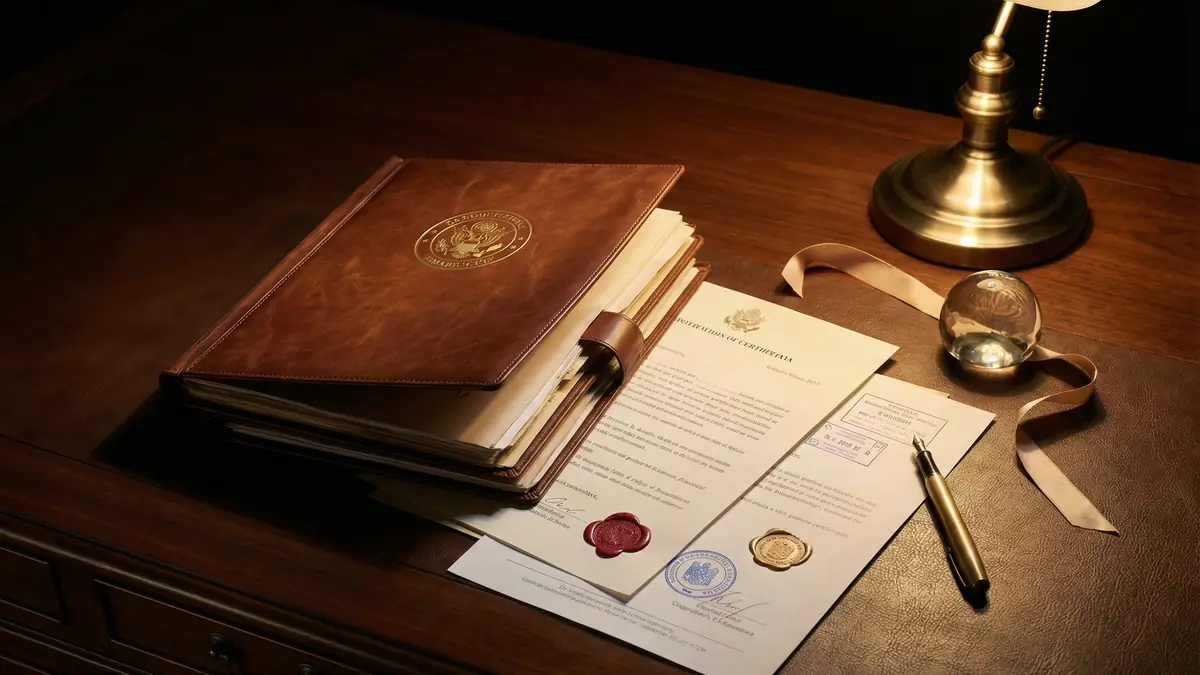
Certified corporate documents on a desk
Illustrative image; it does not represent an official document.

A foreign bank may ask for an apostilled Certificate of Good Standing or Certificate of Status as part of the file needed to open, update, or maintain a corporate account for a U.S. company. The certificate helps establish that the entity exists legally, but it does not replace the full identity, ownership, and signing-authority file that banking due diligence requires.

Quick summary

A foreign bank may ask for: a Certificate of Good Standing or Certificate of Status, an apostille from the issuing state, a certified copy of the Articles, a banking resolution or incumbency certificate, and identification of signers and beneficial owners. Not all of these documents get apostilled the same way. Ask the bank for its exact list before ordering certificates.

What the certificate proves, and what it doesn't

The certificate reflects the entity's official status according to the corporate registry that issued it, for example, that it appears active or in good standing under that state's rules. It does not prove financial solvency, does not reflect any account balance, does not certify that the company is current on every tax obligation, does not identify beneficial owners, and does not establish that a particular individual has authority to open or sign on an account.

Why banks ask for it

Financial institutions opening accounts for foreign legal entities must verify, as part of their compliance policies and customer due diligence rules, that the entity legally exists in its home jurisdiction. An apostilled certificate, issued by a public authority and authenticated for international use, gives the bank a verifiable way to confirm that first point, even though it doesn't complete the rest of the compliance process on its own.

The bank sets the checklist, not a generic online template

Before ordering the certificate, ask the bank in writing for the exact document name, the maximum acceptable age, and the required format (physical, certified digital, or both). Beyond the Certificate of Good Standing, many banks also request a certified copy of the Articles, EIN evidence, an incumbency certificate, a board-signed banking resolution, a register of directors and shareholders, passport copies of authorized signers, proof of address, and a declaration of ultimate beneficial owners.

What the document is called, state by state

The concept is the same across the United States, but the official name varies by formation state. Florida calls it a Certificate of Status; Delaware calls it a Certificate of Good Standing; other states use similar variants. A public registry printout (like a Sunbiz screen print in Florida) should not be confused with the official certificate issued by that registry; they're different documents. For apostille, you need a document that's eligible under the rules of the issuing state's apostille authority. If the bank also requests the Articles, order a separate certified copy, since each record may need its own independent apostille.

The certificate follows the state that issued it, not the operating address

A Certificate of Good Standing or Certificate of Status is apostilled through the competent authority of the state that issued it, not the state where the company keeps its offices or conducts business. A Delaware LLC does not apostille its Certificate of Good Standing in Florida just because it operates out of Miami; the request must go through Delaware's apostille authority. Other documents in the same file, for example powers of attorney or notarized resolutions, can follow a different route depending on where they're signed or certified. Also confirm whether the bank's country is party to the Hague Apostille Convention, in which case an apostille applies, or requires a different consular-legalization chain.

KYC and beneficial owners: the apostille doesn't replace them

Banks apply their own identification, verification, and due diligence procedures to corporate customers. Depending on the bank, the jurisdiction, and the risk profile, they may ask for information about beneficial owners, controlling parties, authorized signers, business activity, and source of funds. In the United States, FinCEN eased its beneficial ownership rules in 2026 so that covered financial institutions no longer have to repeat that identification and verification every time an existing customer opens a new account; they can limit it to the initial account opening, to situations where facts cast doubt on information collected earlier, or to what their own risk-based procedures call for. That doesn't exempt them from ongoing due diligence and monitoring. The apostille on a Certificate of Good Standing doesn't replace any of those controls.

A practical example: opening a corporate account at a Panamanian bank

Suppose a Florida-formed LLC wants to open a corporate account at a bank in Panama to handle payments from Latin American clients. The Panamanian bank will likely ask for, among other things, a current Certificate of Status, a certified copy of the Articles of Organization, an IRS EIN letter, an internal resolution authorizing the account opening and naming the signers, passport copies for those signers, and a beneficial-owner declaration. The Certificate of Status and, in some cases, the certified copy of the Articles typically require an apostille. The EIN letter and internal resolutions follow different rules and shouldn't automatically be apostilled: the bank needs to say whether it will accept the original, a certified copy, a notarized statement, or another form of authentication. Confirming with the bank, document by document, which ones need an apostille and which don't avoids over- or under-apostilling the file.

What to do if the bank rejects the document you submitted

If the bank objects to the certificate, say, because it's too old, issued by a different state than the bank expected, or missing the apostille, it's generally worth requesting the exact reason for the rejection in writing before reordering anything. In many cases the problem is a matter of form, not substance: a correct certificate ordered under the wrong company name, or an apostille processed through the wrong state. Requesting the same type of document again without correcting the original cause of the rejection just produces the same result.

What information banks typically request about beneficial owners

Beyond the corporate certificate, many foreign banks require their own form identifying every individual who, directly or indirectly, owns or controls the company under whatever threshold the bank or its jurisdiction's rules apply, along with a copy of their passport and proof of address. This form doesn't replace the Certificate of Good Standing, and vice versa: they're separate pieces of the same compliance file, and both are typically required together to complete the account opening.

New companies versus established ones

A newly formed company may not yet have enough history for the Certificate of Status alone to satisfy the bank; in those cases, some banks request additional documentation about the source of funds or the company's intended activity. A company with an operating history may have a different documentation profile than a newly formed entity, but the final list always depends on the bank's own compliance policies and risk analysis. Confirming with the bank whether your company's profile requires additional documentation avoids surprises partway through the account-opening process.

Joint accounts and multiple signers

When the account requires more than one authorized signer, the bank may ask for a Certificate of Status and supporting documentation for each individual, plus a resolution establishing how they must sign, individually or jointly, on account transactions. Confirming this signing structure before requesting documents avoids having to redo certifications if the bank requires different wording in the internal resolution.

When a professional filing service makes sense

When the bank requires simultaneous certifications in multiple languages, apostilles from more than one state, or coordination among the state registry, a notary, and a translation office, handing off the full file coordination to a specialized service can reduce the risk of sequencing errors, such as translating before apostilling, or notarizing in the wrong state, compared with managing each step separately without prior experience in the process.

FAQ

Frequently asked questions

Have more questions? Send us your specific case and we'll walk through it with you.

How recent must the certificate be?+
Each bank decides. Many banks set their own maximum age, which can be as short as a few months. Confirm it before ordering the certificate so you don't have to repeat the process.
Are Good Standing and Certificate of Status the same document?+
They serve a similar function, but the exact name, content, and effect depend on the issuing state. Use the issuing authority's official name for the document and confirm the bank accepts that particular document.
Does one apostille cover both the certificate and the Articles?+
No. If the bank requests both, they're normally independent records requiring separate apostilles, even if issued on the same day.
Does the certificate reveal who owns the company?+
Generally not. A Certificate of Status or Good Standing typically doesn't list shareholders or members; that information comes from other documents the bank requests separately.
Can I use the same certificate to open accounts in several countries?+
The same apostille isn't necessarily limited to a single country, but each bank may require a recent certificate, a separate original, or its own documentation rules. Confirm with each bank before reusing a certificate you already obtained.
What if I switch banks after obtaining the certificate?+
If the new bank requires its own format or maximum age, you'll likely need to request a fresh certificate rather than reusing the earlier one, even if the company's information hasn't changed.
Does the certificate come in English, or can it be requested pre-translated?+
The Florida Department of State issues the certificate in English. If the foreign bank requires a version in another language, an independent certified translator is typically needed, since the state does not offer the document pre-translated.

Informational content only. Integramerica is not a law firm and does not provide legal advice. Requirements and final acceptance depend on the receiving authority. Integramerica coordinates document authentication and translation; it does not determine customs classification, product registration, FDA eligibility, origin qualification, or export licensing. Official requirements last reviewed: August 2026.

Contact

Want to confirm the route for your documents?

Send us the document type, issuing state or agency and destination country. We review the document route before you incur unnecessary expense.

Request your document review

Examples: Florida, New York, FBI, U.S. Department of State.
Call us

Please do not include Social Security numbers, financial account information or other highly sensitive personal data.

WhatsAppCallEmail