
How to apostille a power of attorney for use abroad
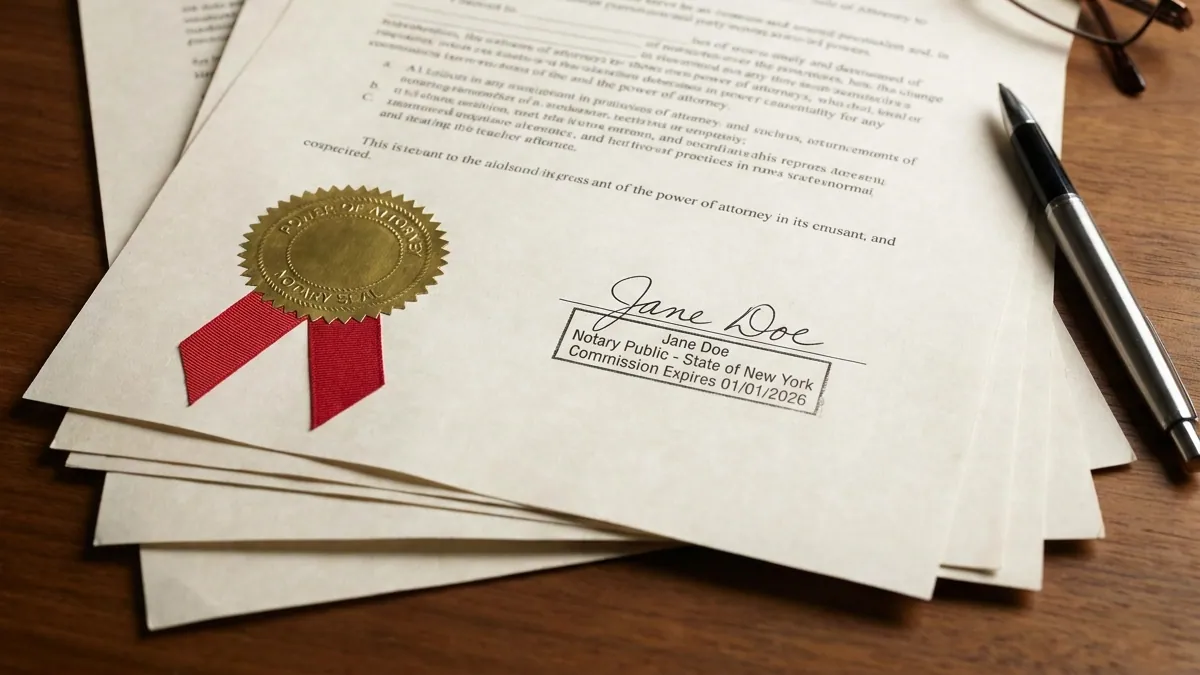
A power of attorney lets another person act on your behalf for a specific matter, such as selling property, representing a company, handling an estate, or completing a banking transaction. When the power of attorney is signed in the United States for use in another country, it may require notarization, an apostille, consular legalization, translation, or additional formalities. The correct route depends on the destination country, the exact wording required by the receiving authority, the state where the notarization takes place, and the type of transaction. That is why it is worth reviewing the draft before signing it.
Before signing a power of attorney for international use, confirm: 1) the country and authority that will receive it; 2) the exact wording or template required; 3) who must sign and before what type of notary; 4) whether witnesses or remote online notarization (RON) are permitted; 5) whether an apostille or consular legalization applies; 6) what type of translation is required. Do not sign first and ask questions later: a poorly prepared power of attorney may have to be redrafted, re-signed, and re-apostilled.
What an apostille does and does not do
An apostille authenticates the signature and official capacity of the notary or public official whose signature appears on the document. It does not verify that the principal understood the scope of the power, that the powers granted are legally sufficient, or that the document complies with the laws of the destination country. According to the HCCH, an apostille certifies the origin of the public signature, not the substantive content of the document. A perfectly valid apostille cannot repair a power of attorney that uses the wrong wording, misidentifies the representative, omits a required witness, or does not grant the authority the receiving authority is asking for.
Who should draft the wording
Integramerica can review the document route, the notarization, and the apostille requirements, but the substantive legal wording should ordinarily come from the attorney, notary, bank, registry, or other professional in the destination country. This especially matters for:
- Real-estate transactions
- Inheritances and probate
- Corporate representation
- Banking powers
- Litigation and administrative proceedings
- Parental or family-law matters
Ask the receiving professional for a draft, a template, or a written list of the required powers before signing. Integramerica reviews the authentication route, but it does not draft legal documents or provide legal advice on what powers to grant; legal sufficiency and final acceptance always rest with the receiving authority.
Apostille or consular legalization for a power of attorney
If the United States and the destination country are covered by the Hague Apostille Convention for this type of document, an eligible notarized power of attorney generally follows the apostille route: a single step before the competent authority of the state. If the destination country falls outside the applicable Convention route, the power of attorney may need a longer authentication chain that includes a federal step and consular legalization. Before signing, confirm which route applies to your case; you can review the full comparison in our guide Apostille or Consular Legalization?
Six steps to apostille a power of attorney
- Identify the exact use and the recipient: a foreign notary, land registry, bank, court, consulate, company, or government authority.
- Obtain the correct wording: ask the receiving authority or the foreign attorney for the required draft, language, powers, names, ID numbers, witnesses, and validity period.
- Confirm the signing formalities: in person or remote online notarization (RON), witnesses, an acknowledgment, or a jurat.
- Sign before the appropriate notary: the notarial certificate must comply with the law of the commissioning state; the notary should not choose or revise the legal powers granted unless separately qualified to do so.
- Obtain the correct apostille or legalization: a state-notarized power of attorney normally follows the authentication route of the state whose notary performed the act, not the signer's state of residence.
- Arrange the translation and delivery: confirm whether the translation is needed before or after the apostille, who may translate it, and whether the apostille itself must also be translated.
Can the power of attorney be signed through remote online notarization?
Possibly, but do not assume remote online notarization (RON) is acceptable just because the notary's state permits it. Verify four things before signing: that the notary is authorized to perform RON; that the state apostille authority can authenticate the resulting format; that the foreign recipient accepts a remotely notarized document; and whether an electronic or paper apostille is required. You can read more in our guide on remote online notarization (RON) and the apostille.
Common types of powers prepared for international use
- Real estate purchase or sale
- Inheritance and probate
- Banking transactions
- Corporate representation
- Litigation or administrative proceedings
- Vehicle sale or registration
- Pension and government-benefit matters
- Authorization to obtain civil records
- Parental or family matters
Each use may require different wording and formalities. A general power is not automatically acceptable where a special or transaction-specific power is required.
Practical examples
Florida power for property in Colombia. The signer in Florida authorizes a representative to sell property in Colombia. The Colombian notary or attorney should first supply or approve the wording; the signer executes it before a Florida notary, obtains the Florida apostille, and completes the required Spanish translation in the accepted format.
New York corporate power for Spain. A company officer signs a corporate power of attorney before a New York notary for use in Spain. The document follows New York's authentication route, not Florida's, even if the company's operating office is in Florida.
Power for a non-Hague destination. A notarized power of attorney for a destination outside the applicable Hague route may need state authentication followed by additional federal and consular steps. Confirm the precise chain before signing.
Common mistakes
- Signing before receiving the foreign authority's required template.
- Using a general power when a special power is required.
- Misspelling the agent's name or ID number.
- Omitting witnesses required by the receiving jurisdiction.
- Using an acknowledgment when a jurat is required, or vice versa.
- Apostilling in the state where the signer lives instead of the state of notarization.
- Using RON without checking whether the foreign recipient accepts it.
- Translating before confirming the authorized translator and the required sequence.
- Assuming the apostille validates the legal content of the power.
- Removing staples or separating the apostille from the document.
Frequently asked questions
Still have questions? Write to us with your specific case and we will review it with you.
Does every foreign power of attorney need an apostille?+
Who should write the wording of the power of attorney?+
Does the power of attorney have to be notarized?+
Which state issues the apostille?+
Can I use a Florida apostille if I signed before a New York notary?+
Can the power of attorney be signed through remote online notarization (RON)?+
Does the apostille make the power of attorney legally valid abroad?+
Should I translate the document before or after the apostille?+
Does a general power of attorney work for any purpose?+
Can I reuse the same power of attorney and apostille?+
What identification details should the power of attorney include?+
Can Integramerica review my draft before I sign?+
Informational content. Integramerica is not a law firm and does not provide legal advice; requirements vary by issuing authority and destination country. Official requirements last reviewed: August 2026.
Want to apostille a power of attorney?
Before signing your power of attorney, send us: the draft or template, the destination country, the name of the receiving authority, the state where it will be signed, whether you plan to sign in person or through RON, and your deadline. We will review the likely authentication route before you sign or incur unnecessary costs.