
Serving the U.S. and clients worldwide since 2004
Digital nomad visa

Spain digital nomad visa: FBI record and apostille
Practical guide · Published July 29, 2026

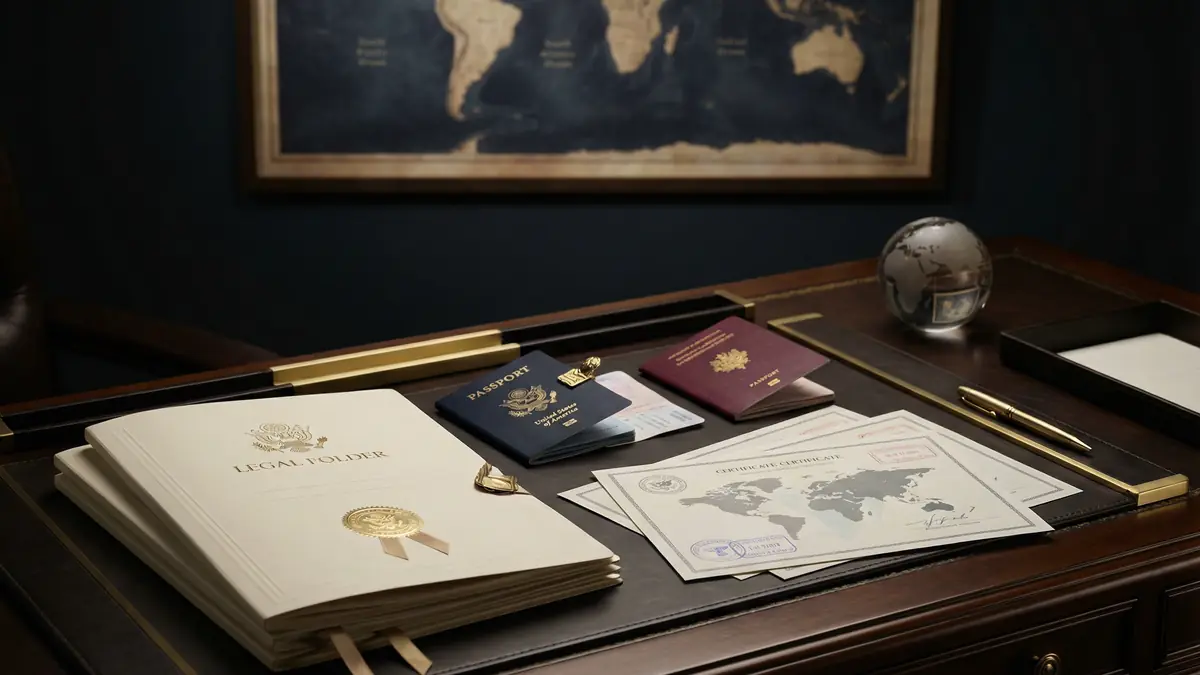
Legal folder, passports and certificates prepared for a visa application
Illustrative image; it does not represent an official document.

Spain created this telework visa through Law 28/2022, known as the Startup Law, whose practical rollout for digital nomads began taking shape in 2023, allowing non-EU professionals to work from Spanish territory for employers or clients based abroad. Document checklists vary by consular district, so always use the requirements published by the Spanish consulate responsible for your U.S. residence, not the checklist of a different office simply because it is closer to you.

Quick summary

For Spain's international telework visa, check: foreign company active for at least 1 year; employment or professional relationship of at least 3 months; authorization to work remotely; an admissible degree or 3 years of professional experience; sufficient financial means; health and Social Security coverage; the FBI Identity History Summary when the consulate requires it; a federal apostille of the FBI report; and an apostille and translation of civil records or other documents when applicable. Employees: only companies outside Spain. Freelancers: up to 20% of professional activity with a Spanish company.

Who this visa is designed for

The visa serves two broad profiles: the employee who keeps an employment relationship with a company established outside Spain, and the self-employed or freelance professional who bills mostly foreign clients. In both cases, the nature of the work must allow it to be performed remotely, and the arrangement must be authorized by the employer or reflected in current contracts. If the applicant works as an employee, they may only work for companies based outside Spain. If they work as a self-employed professional, they may provide a portion of their activity to a company located in Spain, as long as that activity does not exceed 20% of their total professional activity.

Remote work and professional experience

An employee must show that they work for one or more companies domiciled outside Spain; a self-employed professional may keep the share of activity with a Spanish company within the legal limit already noted, as long as most income comes from foreign clients or employers. Either way, applicants are asked for explicit authorization from the employer, or at least no objection, to work remotely from Spain. Applicants must also demonstrate an admissible qualification, for example a university degree or postgraduate degree, vocational training, or studies at a business school of recognized prestige, or alternatively, at least three years of professional experience in functions related to the remote activity they will perform. When possible, it is worth assembling both kinds of evidence: the diploma itself and proof of work history, such as reference letters, past contracts or a portfolio of clients.

Length of the company and professional relationship

The foreign company must demonstrate real and continuous activity for at least one year. In addition, an employee must show an employment relationship of at least three months immediately before applying for the visa, and a self-employed professional must show a commercial relationship of at least three months with one or more foreign companies.

Income, insurance and Social Security

The principal applicant must demonstrate sufficient financial resources under a formula that Spanish regulations tie to the country's minimum wage, with additional amounts if dependents are included in the application. Because that reference figure is updated periodically, it should never be treated as fixed; confirm the figure in effect when you actually assemble your file, not the one quoted in an older source. The file must also meet the health coverage and Social Security requirements that apply to the type of employment or professional relationship. Depending on the case, this can be proven with private medical insurance or coverage through the applicable public system. This point should be confirmed with the competent consulate because it depends on the specific employment situation.

FBI background check: why a state report is not enough

One of the points where applicants most often get stuck is the criminal background check. When the consulate requires a U.S. background check, check whether your checklist specifically asks for the FBI Identity History Summary. A state, local, or private report should not be assumed to be an acceptable substitute.

Because it is issued by a federal agency, the apostille for this document comes from the U.S. Department of State (Office of Authentications), not from Florida's Secretary of State or any other state authority. A frequent mistake is sending the FBI record to the wrong state office; the document comes back unauthenticated and the process has to start over, with all the delay that entails.

How the apostille and translation fit together

Order matters here. The FBI record is requested first, either by mail or through a fingerprint-based channel. Once you obtain the FBI Identity History Summary in a form accepted for authentication, the federal apostille is processed through the U.S. Department of State. Only after it has been apostilled should the official Spanish translation be completed, according to the competent consulate's checklist. Explicitly confirm whether the apostille text itself must also be translated, since that requirement can vary between consulates. Translating before apostilling, or apostilling a copy instead of the original, are two common reasons a document gets rejected.

Protect the physical integrity of the apostilled document: do not re-staple it, separate the pages, or photocopy them loose if the consulate requires the original with the apostille attached or bound to it. A document that has come apart can raise doubts about its authenticity during review.

Other U.S. documents in the file

Beyond the FBI record, the file may include other U.S.-issued documents, such as degrees, academic transcripts, or family civil records (birth or marriage certificates, for example, if dependents are included), and, for self-employed applicants, company formation certificates or proof of business activity. These may require an apostille and translation depending on the applicable checklist; some consulates accept certain educational records without an apostille, depending on how they are used. Each document follows its own authentication route: degrees and civil records are usually apostilled by the state where the document was issued or notarized, not automatically by the federal Department of State.

Employment contracts, company letters and bank statements are a different case. These private documents do not carry an apostille on their own unless they are first notarized before a U.S. notary public, and not every consulate requires notarization or an apostille for them. Before apostilling an employment letter or bank statement "just in case," confirm with the consulate whether the current checklist actually asks for it; apostilling something that was never required does not speed up the process, it only adds time and cost.

Plan backward from your consular appointment

As with any consular procedure, it helps to build your timeline backward from the date you expect to submit your application, rather than forward from the day you start gathering documents.

  1. Confirm the current document checklist from the consulate with jurisdiction over your U.S. residence.
  2. Identify which documents have a limited validity period (the FBI record is generally treated as valid for only a set window of time) and which do not expire.
  3. Request the slowest documents first, typically the FBI record and any civil record that must be requested from another state.
  4. Send the eligible federal and state documents to the corresponding apostille authority.
  5. Arrange the official translation only after each document has already been apostilled.
  6. Assemble the complete file and check that no apostilled document is damaged, unstapled, or past its validity window before your appointment.

Visa from the U.S. versus authorization from within Spain

If you apply from a Spanish consulate in the United States, the international telework visa can be granted for up to one year. If you are already legally in Spain and meet the requirements, you can apply for an international telework residence authorization for up to three years. Renewals can be granted for periods of up to two years while the conditions that gave rise to the authorization are maintained.

Most U.S. applicants start the process at their corresponding consulate in the United States before traveling. Applying for the authorization while already in Spanish territory has its own procedure and documentation, and not every applicant qualifies to follow it. Deciding which route fits your situation depends on your specific immigration status and should be confirmed with the consulate or an immigration advisor, not with this guide alone.

FAQ

Frequently asked questions

Have more questions? Send us your specific case and we'll walk through it with you.

Will a state or private background check work instead?+
No. The U.S. consular checklists reviewed specifically require the FBI Identity History Summary, not a report from a local police department, a county, or a private background-check company.
Where is the FBI record apostilled?+
At the U.S. Department of State, because it is a federal document. It is not apostilled by Florida's Secretary of State or any other state authority, even if you live there.
Can I follow another Spanish consulate's checklist if it's more convenient?+
That is not advisable. Each Spanish consulate in the United States has jurisdiction over a defined territory, and its checklist applies only to applicants who reside within that district. Filing with another office's requirements can lead to objections or delays.
Does the apostille guarantee my visa will be approved?+
No. The apostille only authenticates the signature and the official capacity of whoever signed the underlying document; it does not evaluate or certify the content, and it does not replace the consulate's review of the rest of your file, your income, or the purpose of your stay.
How far in advance should I start gathering these documents?+
There is no single number that applies to every case, since it depends on FBI processing timelines, the apostille authority's current volume, and consular appointment availability. As a general rule, start the FBI record process as early as possible, since it tends to be the slowest step in the chain.
Do I need to translate documents that don't carry an apostille, like letters or contracts?+
It depends on what the current consular checklist requires. Some private documents are accepted in English, while others require an official Spanish translation even without an apostille. Confirm this document by document before submitting your file.
How long can the visa last?+
If applied for as a visa from abroad, it can be granted for up to one year. If applied for as a residence authorization while already in Spain, it can be granted for up to three years, with renewals of up to two years while the conditions that gave rise to the authorization are maintained.
Can I work for Spanish clients?+
Only if you work as a self-employed professional and stay within the legal limit: that activity cannot exceed 20% of your total professional activity. Employees may only work for companies based outside Spain.
How long must the foreign company have existed?+
The regulations require the foreign company to show real and continuous activity for at least one year before the application.
How long must I have been working with the company or client?+
At least three months immediately before the application, either as an employment relationship (employees) or a commercial relationship (self-employed professionals).
Do I need a university degree?+
Not necessarily. The regulations allow it to be substituted with at least three years of admissible professional experience in functions related to the remote activity you will perform.
Can I include family members in the application?+
Yes. Per the current guidance from the Consulate of Spain in New York, this can include a spouse or partner, dependent children, and dependent ascendants, as long as the relationship is documented and the corresponding documents include an apostille and translation when applicable.

Informational content only. Integramerica is not a law firm and does not provide legal advice. Requirements and final acceptance depend on the receiving authority. Integramerica provides document preparation, apostille, legalization, translation, and attorney referrals when appropriate; it does not determine visa eligibility.

Contact

Preparing an application for Spain's Digital Nomad Visa?

Send us the consulate with jurisdiction over you, the current checklist, and the U.S. documents you need to submit. We can review which require federal apostille, state apostille, or translation, without replacing the consulate's own immigration evaluation.

Request your visa file review

Call us

Please do not include Social Security numbers, financial account information or other highly sensitive personal data.

WhatsAppCallEmail