
Serving the U.S. and clients worldwide since 2004
Powers of attorney

U.S. power of attorney for Colombia
Practical guide · 7 min read · Published July 29, 2026

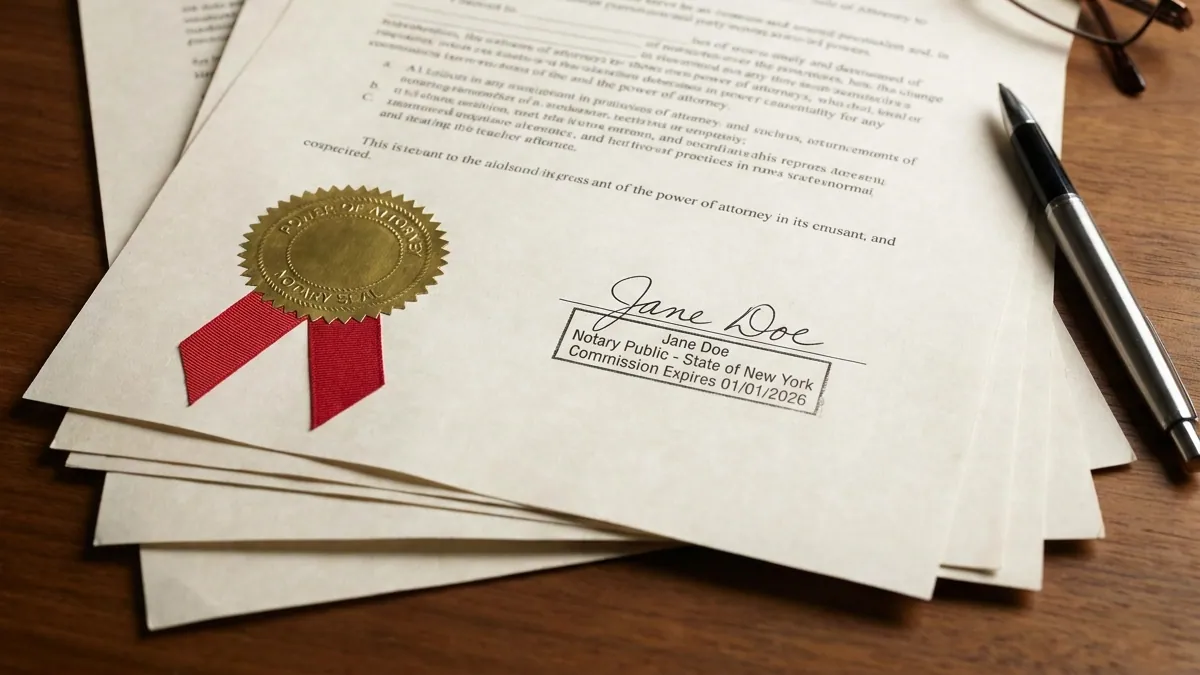
Notarized power of attorney next to an apostille seal
Illustrative image; it does not represent an official document.

A power of attorney signed in the United States only works in Colombia if three pieces line up: the wording grants the exact authority the receiving entity requires, the signature was authenticated through the correct channel, and the document arrives in the language and format the Colombian office accepts. Before signing anything, ask the Colombian notary, bank, registry, attorney or other receiving entity to confirm the required wording and authority. Fixing a power of attorney after it has been apostilled almost always costs more time than getting it right the first time.

Special and general powers of attorney

A special power of attorney is limited to one or more specific acts and is what banks, notarial offices and probate authorities in Colombia usually request: selling a particular property, representing someone in a specific probate matter, withdrawing funds from an identified account, or signing the closing documents for an asset already described in the power itself. A general power authorizes the agent to act across a broad range of matters and, because of that scope, generally must be executed as a public deed in Colombia or its recognized equivalent abroad, not a simple notarial form.

An apostille cannot repair incomplete wording, and it does not establish that the granted powers are sufficient for the transaction. It only certifies the origin of the signature and the official capacity of the person who authorized it. If the document does not precisely describe the act, the property or the account, the Colombian entity can reject it even though the apostille itself is perfectly valid.

What the draft should cover before you sign

The wording of the power of attorney (not the apostille) is what most often causes rejections. Before scheduling a notarial or consular appointment, confirm with whoever will receive the document in Colombia (a notarial office, bank, probate authority, court or registry) what the text needs to include:

  • Full identification of the grantor and the agent, including ID or passport numbers.
  • A precise description of the property, account, case or transaction the agent will handle (property address, title registration number, account number, case docket number, as applicable).
  • Express authority: under Colombian law, certain acts (such as selling, mortgaging or settling a claim) must be explicitly stated, and a generic grant of authority is not enough.
  • Duration and, if relevant, conditions for revocation.
  • If the grantor wants the power to be effective outside Colombia as well, the text should say so.

Route 1: acknowledgment at a Colombian consulate

The grantor may go to a Colombian consulate in the United States to acknowledge their signature or, in some cases, execute the corresponding deed directly before the consul, who exercises notarial functions for Colombian nationals and, for certain transactions, for foreign nationals as well. This route is usually handled in Spanish, and some consulates require the document to arrive unsigned so the signature is placed in the officer's presence. Signing beforehand can force you to redo the whole appointment. The practical advantage of this route is that a document acknowledged before a Colombian consulate typically does not need a separate U.S. apostille, because the consulate itself acts as a Colombian authority. Each consulate (Washington, New York, Miami, Chicago, Houston, Los Angeles and others) may have slightly different appointment rules, supporting documents and forms, so confirm the exact procedure with the office covering your jurisdiction before showing up.

Route 2: U.S. notary and state apostille

When a consular appointment is not practical (due to distance, availability or urgency), the power of attorney can instead be signed before a notary public commissioned in a U.S. state and then apostilled. It matters that the U.S. notarial system is decentralized: each notary is commissioned by a specific state, and the apostille must be obtained in that same state, generally from the Secretary of State's office or the equivalent authority. Florida does not apostille notarial signatures made by a notary commissioned in another state, and no apostille office accepts a photocopy in place of the original document bearing the notary's ink signature and seal. The correct sequence is: (1) confirm which state commissioned the notary who will sign, (2) sign the power of attorney before that notary, and (3) take the original notarized document to the apostille office in that same state.

Official translation and delivery to Colombia

If the power of attorney was drafted in English, the Colombian entity receiving it will almost always require an official Spanish translation, prepared according to that entity's own rules about who may translate (a notarial office, bank or court may apply different standards). A practice that avoids delays is apostilling the document in its original language first and translating afterward, so the translation accompanies, but does not replace, the apostilled original. Keep the apostille physically attached to the document exactly as the issuing authority delivered it: do not separate pages, do not re-staple them in a different order, and do not scan the set apart, since some Colombian offices verify that the package has not been altered.

Common mistakes that delay use of the power of attorney

  • Signing the document before the appointment when the consulate or the underlying rule required signing in the officer's presence.
  • Drafting generic authority when the act (sale, mortgage, settlement) requires it to be stated expressly.
  • Apostilling in a different state than the one that commissioned the signing notary.
  • Sending a photocopy or a printed PDF instead of the original with a physical apostille.
  • Translating before confirming which translator the receiving entity accepts.
  • Leaving out the exact description of the property, account or case the power of attorney refers to.
FAQ

Frequently asked questions

Have more questions? Send us your specific case and we'll walk through it with you.

Does the apostille validate the contents of the power of attorney?+
No. The apostille authenticates the signature, seal and official capacity of the person who authorized the document; it does not certify that the granted powers are correct, sufficient or properly drafted for the specific transaction.
Can Florida apostille a power of attorney signed before a New York notary?+
No. The apostille comes from the authority of the state where the signing notary is commissioned, regardless of where the grantor lives or where the document will ultimately be used.
Will a generic template found online work?+
Not necessarily. The Colombian recipient (notarial office, bank, probate authority or court) should confirm the exact transaction, the required details and the express authority needed before you sign and apostille.
Can I revoke a power of attorney that has already been apostilled?+
Yes. Revocation generally follows a formality equivalent to the original grant (signing before a notary or consulate, and in some cases an apostille as well), and it is wise to notify the entity where the original power of attorney was filed.
Does the document need to be drafted in Spanish?+
It depends on the receiving entity. Some Colombian consulates and notarial offices require the document to arrive directly in Spanish; others accept the English original accompanied by an official translation. Confirm the exact requirement before drafting the text.
How long does it take to apostille a power of attorney?+
It varies by state, time of year and whether an expedited service is used. There is no single timeline that applies to every state; confirm the current estimate with the apostille office or with whoever is handling the process for you.
Contact

Need to prepare these documents?

Send us the destination country and a clear copy. We can help identify the applicable document, apostille or translation route.

Request your document review

Examples: Florida, New York, FBI, U.S. Department of State.
Call us

Please do not include Social Security numbers, financial account information or other highly sensitive personal data.

WhatsAppCallEmail