
Serving the U.S. and clients worldwide since 2004
Marriage in Colombia

Requirements for a U.S. citizen to marry in Colombia
Practical guide · 9 min read · July 29, 2026

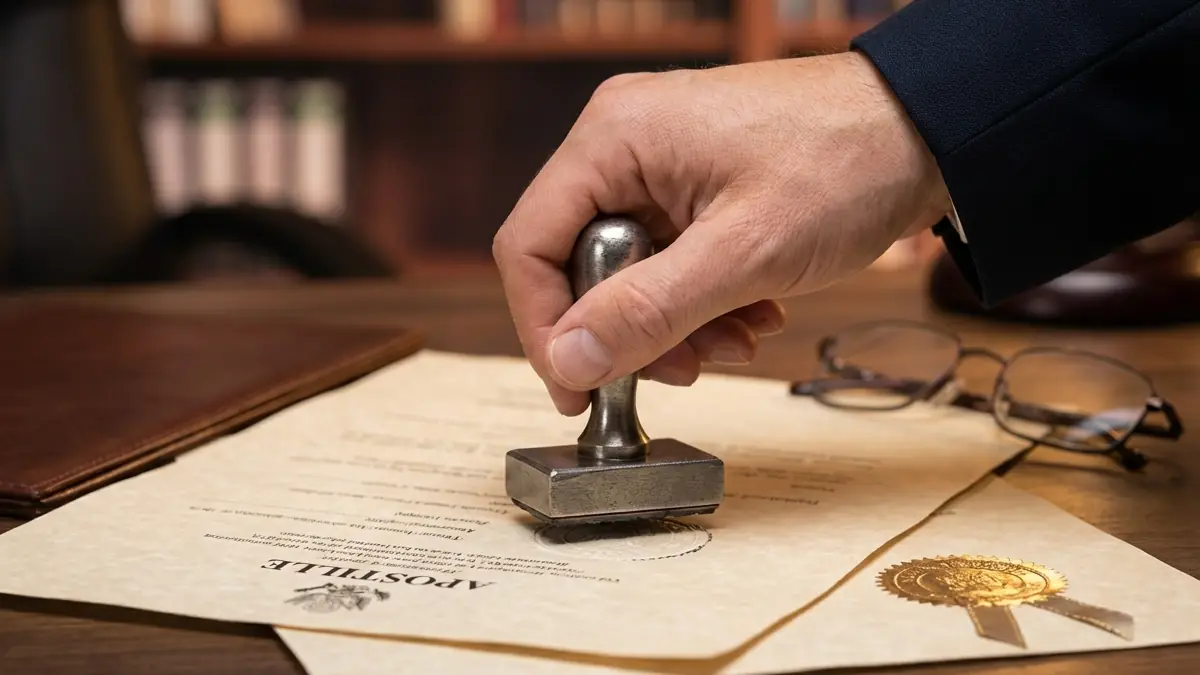
Official placing an apostille stamp on a document
Illustrative image; it does not represent an official document.

A U.S. citizen can marry civilly in Colombia, but the exact document list depends on the notaría (notarial office) chosen for the ceremony and on whether the foreign national is considered domiciled in Colombia or not. Colombian law sets minimum requirements for the foreign national not domiciled in Colombia, but the notaría you choose may request additional documents or clarifications depending on the specifics of your file. This guide explains how to prepare, from the United States, the documents Colombian notarías most commonly request, without replacing the notaría's own review, which always has the final word on what your specific file needs.

Quick summary

For the U.S. citizen not domiciled in Colombia, what is commonly prepared: a certified birth certificate, proof of single status or an accepted equivalent, proof that any prior marriage has ended, an apostille on each applicable U.S. document, and a Spanish translation in the form the notaría accepts. The birth and single-status documents in this category generally must be less than three months old under Colombian law.

First question: are you domiciled in Colombia?

The specific rule for a foreign national not domiciled in Colombia generally calls for a birth record and proof of single status, or an accepted equivalent. A person domiciled in Colombia, someone with established residency or who has lived there habitually for some time, may receive a different list, with additional or different requirements. That is why the first step, before gathering any document, is to contact the notaría that will perform the marriage and ask explicitly which category applies to your case.

Documents commonly prepared in the United States

  • Valid passport.
  • Certified copy of the birth certificate (not a plain photocopy or a hospital "keepsake" certificate).
  • Single-status evidence or the equivalent document accepted by the notaría.
  • If previously married, official proof of the divorce, annulment or the former spouse's death.
  • The corresponding apostilles and Spanish translations for each of the above documents.

A plain photocopy of the birth certificate does not substitute for a certified copy issued by the vital-records office of the relevant state. The apostille must be obtained from the state that issued the certificate, not necessarily the state where the person currently lives, because the apostille certifies the signature of the official who issued the document, and that official belongs to the state of origin.

Does the United States issue a national single-status certificate?

The United States has no single federal marital-status certificate and no national marriage registry. Depending on the state, proof of single status may consist of a notarized sworn affidavit, a Single Status Statement issued by the state's vital-records office, or an official search of marriage records; Florida, for example, offers a Single Status Statement based on a search across all 67 counties. The Colombian notaría must confirm which of these alternatives it accepts for your case, along with the exact wording and language required, before it is signed, notarized and apostilled. See our guide on the single-status certificate to marry abroad for more detail.

Document validity: confirm before ordering

For the foreign national not domiciled in Colombia, Decree 2668 of 1988, as amended by Decree 1556 of 1989, specifically requires that the birth record and the single-status certificate or its equivalent be less than three months old when the application is filed. Since the notaría may request additional documents or apply its own practical requirements, it is worth confirming the current checklist before ordering the documents. Obtaining a certified record, apostilling it and translating it takes time, and having to repeat the process because a document expired is one of the most common and avoidable setbacks.

Apostille and Spanish translation

  1. Obtain the certified copy of the birth certificate or prepare the single-status affidavit the notaría accepts.
  2. Request the apostille from the authority of the state that issued the record, or the state where the notary who certified the affidavit is commissioned.
  3. Apostille the source document first, in its original language.
  4. Arrange the Spanish translation required by the receiving authority (the notaría may require an official translation prepared according to the rules applicable in Colombia).

If the official translation is prepared in Colombia for use in Colombia, it currently does not require an additional apostille. The U.S. source document still needs to arrive properly apostilled. For added legal certainty, Colombia's Cancillería recommends apostilling the source document first and translating it afterward. If the translation is prepared abroad, confirm with the notaría what authentication chain it will require.

After the application is filed

The marriage application can be filed in person or, in some cases, through a duly authorized agent. Once the application is filed with complete requirements, the notaría must post a public notice (edicto) for five business days before proceeding with the ceremony. Certain particular situations, such as a prior marriage, children from another relationship, marital agreements, an agent acting on someone's behalf, or differences in how a name is spelled across documents, can generate additional requirements that the notaría only identifies once it reviews the complete file, so it is wise to submit everything with plenty of lead time before the desired date.

If you were previously married

If the U.S. citizen was previously married, the notaría may require the divorce decree, the annulment order or the death certificate proving that the prior marriage ended. That document may itself require certified issuance, an apostille and translation, just like the birth certificate or the single-status evidence. Do not assume the single-status affidavit alone replaces proof that the prior marriage ended.

Common mistakes that delay the process

  • Apostilling the birth certificate in the state of current residence instead of the state that issued it.
  • Drafting a single-status affidavit without first confirming the exact wording the notaría accepts.
  • Translating a document before it has been apostilled.
  • Submitting uncertified copies instead of official certified copies.
  • Not checking the specific validity window for each document before ordering it.
  • Leaving out official proof of a prior divorce or death when it applies.
FAQ

Frequently asked questions

Have more questions? Send us your specific case and we'll walk through it with you.

Must the birth certificate be apostilled?+
Normally yes, because it is a U.S. public document that will have legal effect in Colombia. The apostille comes from the state that issued the certified record, not the state of current residence.
Can the single-status certificate be a notarized affidavit?+
In many cases, yes. Since the United States has no single federal marital-status certificate, proof of single status often consists of a notarized sworn affidavit, a state Single Status Statement, or an official search of marriage records, depending on the state. The Colombian notaría must confirm which of these it accepts for your case.
Does Florida issue a Single Status Statement?+
Yes. Florida's Bureau of Vital Statistics can search marriage records across the state's 67 counties and issue an official No Record Found statement when no marriage is found, which can then be apostilled for use in Colombia.
Can I use any single-status affidavit template?+
Not advisable. The Colombian notaría should confirm which equivalent document it accepts and what wording it must contain before you sign it and have it notarized and apostilled.
Must the documents be less than three months old?+
For the foreign national not domiciled in Colombia, Decree 2668 of 1988, as amended by Decree 1556 of 1989, requires the birth record and the single-status certificate or its equivalent to be less than three months old when the application is filed. Confirm with the notaría whether any additional requirement applies to your case.
Should translation come before or after apostille?+
For added legal certainty, Colombia's Cancillería recommends apostilling the source document first, in its original language, and translating afterward. If the translation is prepared in Colombia for use in Colombia, it currently does not require an additional apostille.
Does a translation done in Colombia need an apostille?+
Currently, an official translation prepared in Colombia for use in Colombia does not require an additional apostille. The U.S. source document still needs to arrive properly apostilled before it is translated.
Can the marriage be processed through a power of attorney?+
In some cases the application can be filed through a duly authorized agent, but this depends on the notaría and can create additional requirements for the power of attorney itself (wording, notarization, apostille and translation). Confirm this directly with the notaría before relying on this option.
What happens if I was previously married?+
The notaría may require the divorce decree, the annulment order or the death certificate proving the prior marriage ended. That document may itself require certified issuance, an apostille and translation; the single-status affidavit alone does not replace this proof.
How much time should I budget to gather everything?+
There is no single timeline, since it depends on how many documents you need, which states issued them, and appointment availability for notarization and apostille. As a practical rule, start the process as far in advance of your desired wedding date as possible.
Does a U.S. citizen need a visa to marry in Colombia?+
This guide covers the civil documents needed for the marriage itself, not the immigration requirements for entering Colombia, which depend on tourist-stay rules or another applicable category; confirm those separately with the Colombian immigration authority.
Contact

Need to prepare these documents?

Send us the city or notaría in Colombia, your U.S. state of birth, whether you were previously married, and any checklist the notaría has given you. We'll review the documentary route, apostille and translation before you order new documents.

Request your document review

Examples: Florida, New York, FBI, U.S. Department of State.
Call us

Please do not include Social Security numbers, financial account information or other highly sensitive personal data.

WhatsAppCallEmail